

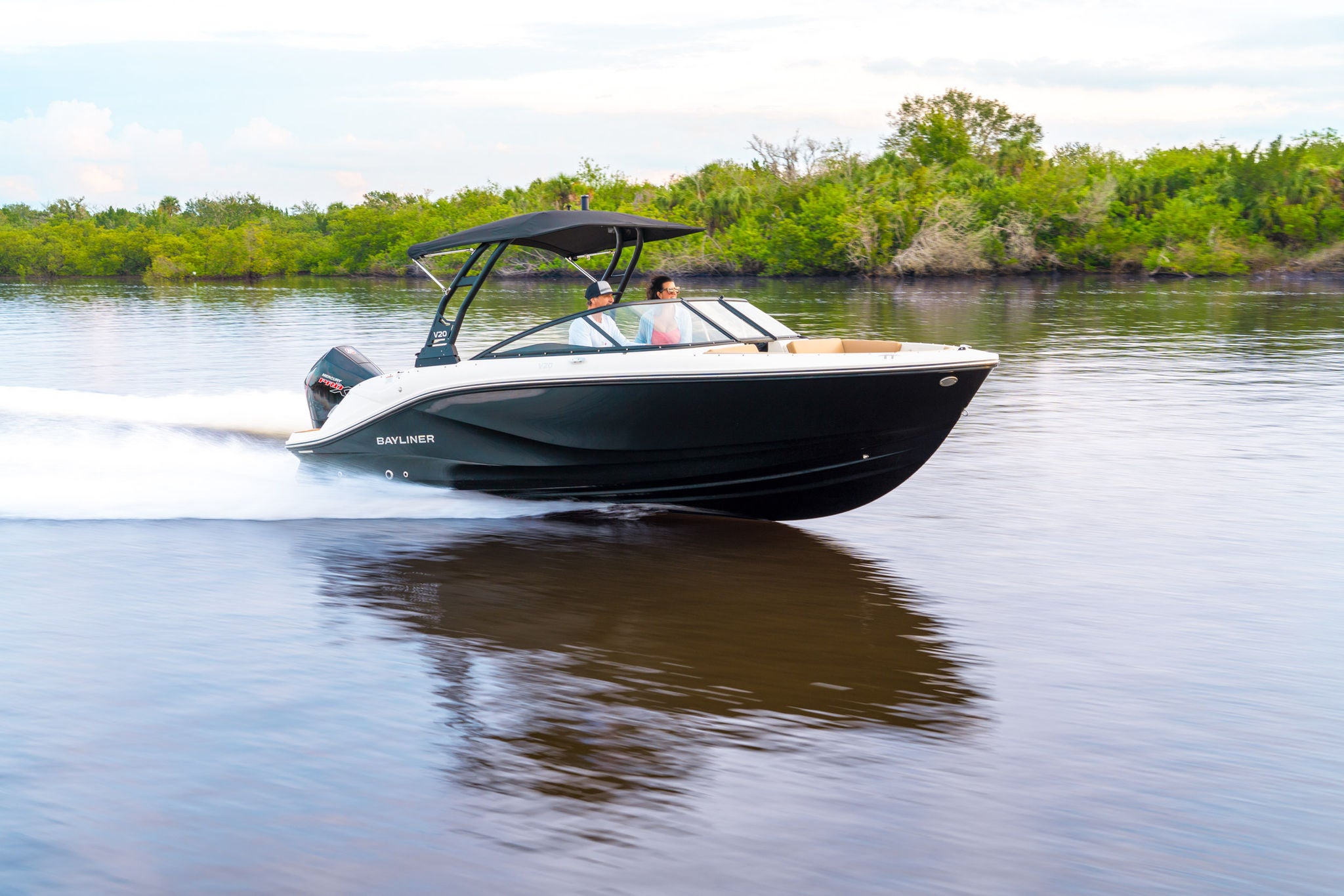
What Makes a New Bayliner Boat So Reliable
The information provided is for general informational purposes only. This information is based on the author’s personal experience and does not constitute financial or legal advice. You should consult with a professional and/or conduct your own independent research to verify any information in this post prior to making a financial decision or otherwise.
What Makes a Bayliner Boat So Reliable
The Quiet Engineering Behind Every Bayliner
Pull the cushions out of most boats and you'll find the truth about how they're built. Under the seating, behind the access panels, that's where a boat's real character lives, long before it ever shows up on a spec sheet. Pull the cushions on a current Bayliner and what's underneath tells a specific story: a hull poured and bonded as one continuous structure, a Mercury engine wearing a warranty that doesn't get outsourced to a third party, and a set of design choices that change depending on whether the boat in front of you is meant for tubing behind the kids or running livewell water to a cooler full of redfish. None of that shows up in a walk-around at the dealership. All of it shows up five years later, which is exactly when it matters most.
The Hull Isn't Assembled. It's Grown.
Most people picture a boat hull as a shell with parts bolted inside it — stringers here, a transom there, a deck dropped on top. That's not how a Bayliner comes together. Every current model is built through a process the company calls Unitized Construction, where the hull, stringers, and transom are bonded by hand into a single fiberglass-encapsulated structure before the boat is anything else. There's no seam where water can start working its way into a stringer, no mechanical fastener slowly loosening under years of wave impact. The whole structure moves as one piece because it is one piece. It's the reason Bayliner can put a lifetime hull warranty behind every model without hedging, and it's the sort of detail that sounds like marketing copy right up until an owner sees a competitor's hull cut open at a boat show and realizes how different “bonded” and “fastened” really are.
Stability Isn't a Feature. It's a Maintenance Strategy.
Ask a dealer what shortens a boat's working life and the answer rarely starts with the engine. It starts with motion — the constant, low-grade stress of a hull that rocks, pitches, and slaps against chop hour after hour. Every rivet, hinge, and canvas snap on board is fighting that motion, and the boats that fight it hardest tend to need the most attention over time. The Element and M Series lines are built around the M-Hull, a shape engineered less for speed and more for staying flat and predictable at rest and underway. That's a comfort win, obviously. It's also a quieter mechanical one: less flex through the structure, less repeated stress on hardware and upholstery, less reason for a five-year-old boat to feel like it's aged ten. Stability, in other words, is doing maintenance work before maintenance is ever required.
One Company Builds the Boat. The Same Company Backs the Engine.
Here's a detail that gets lost in most boat-shopping conversations: Bayliner and Mercury Marine share a parent company in Brunswick, which means the engine on the back of a new Bayliner isn't a third-party component with a separately negotiated warranty bolted onto someone else's hull. It's a Mercury FourStroke outboard or MerCruiser sterndrive, backed directly by Mercury, serviced through one of the largest dealer and parts networks anywhere in recreational boating. Bayliner layers its own coverage on top — a five-year limited deck warranty and a one-year parts and components warranty standard on every model — and BaylinerCare extends that protection out to five or eight years for buyers who want the peace of mind locked in up front. What that adds up to in practice: a V22 or VR6 buyer choosing between outboard and sterndrive power isn't gambling on reliability either way. They're choosing between two well-supported setups, and the real decision comes down to how much they want that open swim platform versus a bit more room up front.
Built for the Job, Not Just Built Well
A brand-wide warranty tells you Bayliner stands behind its boats. It doesn't tell you why a Trophy center console and an Element deck boat, sitting twenty feet apart at a dealership, are engineered so differently underneath the surface. That answer changes by model, and it's worth knowing before signing anything.
The Element E-Series and M Series deck boats keep things almost stubbornly simple: molded-in storage instead of bolt-on bins, controls laid out the way a car's dashboard is laid out, nothing on board that requires a manual to understand. That's a deliberate restraint, not a missing feature list, and it's why these hulls tend to stay easy to own for as long as a family keeps them.
The V Series and VR Series bowriders hand buyers a real fork in the road between outboard and sterndrive power, and the redesigned V22 — built at Bayliner's Knoxville, Tennessee facility and following more than a decade of VR6 sales success — adds a wider beam and more storage without touching the formula that made its predecessor work. Families choosing between the two configurations aren't picking a winner; they're matching the rig to whether weekends mean towing skiers or packing in more people with less fuss.
Trophy center consoles get judged by a different standard entirely, one set by anglers who don't care how a boat looks at the dock. Washdown and livewell plumbing built for daily abuse, a deep-V entry that keeps a long run to the fishing grounds from turning into a chiropractor's bill, and a deck layout where rods and tackle have an actual home instead of just open space — these are choices made for a boat that's going to get used hard, every weekend, for years.
Step up to the D Series deck boats and the equation shifts again: more amenities, more electrical systems for stereo and lighting, more of the features that make a bigger boat feel like a bigger investment. Every one of those extra systems sits on the same Unitized Construction foundation as the smaller models, and every one carries the same warranty coverage. More boat doesn't mean less confidence.
What Happens After the Dealership
Good engineering only carries a boat so far without the infrastructure to back it once it's out of the showroom. A lifetime limited transferable hull warranty holds its value at resale time, since the next buyer inherits the same coverage rather than starting from zero. One of the largest dealer and service networks in the industry means a part or a technician is rarely more than a short drive away, in nearly any coastal or lake town in the country. And a construction philosophy built around fewer failure points means routine maintenance stays routine, instead of turning into a specialty project every time something needs attention. From the compact Element E16 up through the flagship V22, that combination — one-piece construction, Mercury-backed power, and a design built around how the boat gets used — is what makes a Bayliner worth trusting for the long haul, not just the first season.
This website does not provide financial or legal advice. The information available on this website is provided for general informational and educational purposes only and is not a substitute for professional advice. You should consult with the appropriate professionals prior to making any financial decisions. YOUR USE OR RELIANCE ON ANY OF THE INFORMATION PROVIDED HEREIN IS SOLELY AT YOUR OWN RISK. UNDER NO CIRCUMSTANCE SHALL WE HAVE ANY LIABILITY TO YOU FOR ANY LOSS OR DAMAGE OF ANY KIND INCURRED AS A RESULT OF THE USE OR RELIANCE ON ANY INFORMATION PROVIDED.