

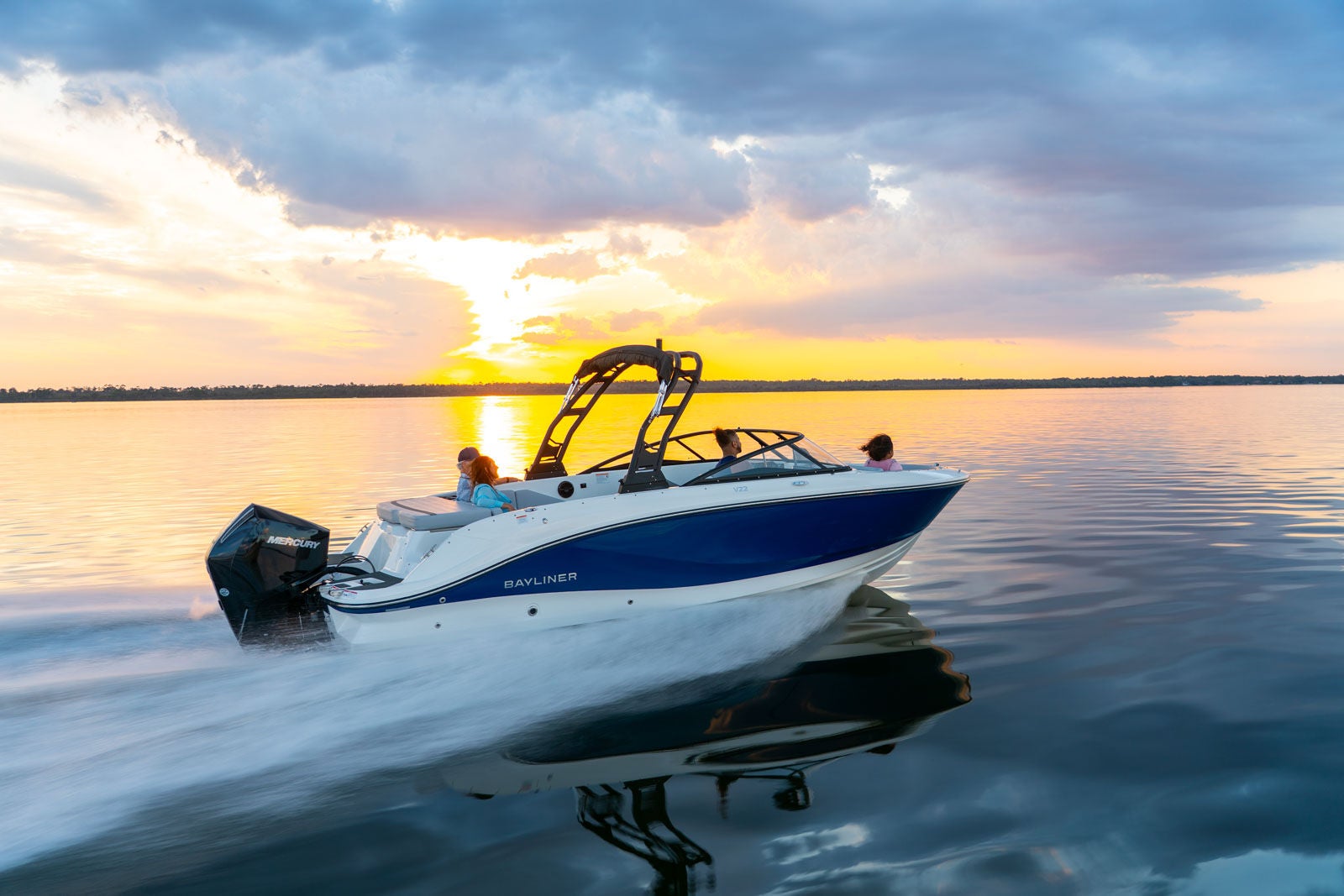
Deck Boat vs Bowrider: Which is Right for You?
The information provided is for general informational purposes only. This information is based on the author’s personal experience and does not constitute financial or legal advice. You should consult with a professional and/or conduct your own independent research to verify any information in this post prior to making a financial decision or otherwise.
Deck Boat vs. Bowrider: Which Bayliner Fits Your Family's Weekends?
Somewhere between the sandbar crowd and the tubing crowd sits the question every first-time Bayliner buyer eventually asks: deck boat or bowrider? The D Series and the V Series both get a family on the water fast, but they solve that job in almost opposite ways. One widens the bow until the boat feels like a floating porch. The other narrows it into a scooped, sporty entry built for speed and spray.
Neither approach is wrong. What matters is which one matches how a Saturday really unfolds — who climbs aboard, how many coolers come along, and whether the afternoon ends anchored off a sandbar or bouncing behind a tow rope.
Here's the breakdown, section by section, with the kind of detail that usually gets left out of the showroom pitch.
At a Glance: D Series vs. V Series
Feature | D Series Deck Boat | V Series Bowrider |
Built Around | Space, comfort, and socializing | Speed, versatility, and watersports |
Ride at Anchor | Sits flat and steady off a sandbar | Deep-V hull rocks a bit more when parked |
Interior Layout | One open deck, no boundaries | Distinct bow, cockpit, and swim zones |
Passenger Flow | Walk end to end without stepping over anyone | Natural separation between loungers and riders |
Seating | Stretches across the full width of the boat | Tighter, more performance-focused footprint |
Watersports | Fine for casual tubing | Built for regular skiing, wakeboarding, tubing |
Storage | Big, open bins for coolers and beach gear | Dedicated compartments for ropes, vests, boards |
Swimming & Sandbars | Where it earns its keep | Solid, but less floor space for lounging |
Trailering | Rides higher, lighter tongue weight | Sits lower on the trailer, more tongue weight |
First Boat for the Family | Forgiving and easy to learn on | Approachable, but more of a step up in feel |
Side-by-Side Family Comparison
D Series Deck Boats
The D Series is built around one idea, and it doesn't apologize for it: more usable space, full stop. The hull carries its width almost all the way to the bow, turning what would be dead space on a narrower boat into real seating, cooler room, and space for a cousin's oversized inflatable. Families who spend most of a day anchored, swimming, or just talking tend to end up here without much debate.
What owners notice after a season or two:
- Seating that stretches farther than the boat's length would suggest
- An open floorplan that lets a toddler wander from bow to stern without anyone stepping over a console
- Sightlines that make it easy to keep an eye on everyone at once, even mid-conversation
- Layouts flexible enough to absorb kids, a dog, and last-minute guests without a seating chart
- A ride that feels less like piloting a boat and more like hosting on one
V Series Bowriders
The V Series takes a sportier route to the same goal. A traditional bow-and-cockpit layout carves the boat into separate zones — sunbathing up front, driving and socializing in the cockpit, gear and swimmers at the platform — which ends up suiting families who bounce between activities rather than settling into one for the whole afternoon.
What owners notice after a season or two:
- A deep-V entry that stays composed when the lake gets choppy by mid-afternoon
- Bow seating that still feels private even with the cockpit in full swing
- Handling that rewards a driver who wants to drive, not just idle around
- A layout built with towing in mind, not retrofitted for it
- Enough range of activities that boredom rarely becomes the reason for heading in early
How Families Really Use the Boat
Choose a D Series If Your Family Loves:
- Sandbar afternoons that stretch into evening
- Floating, swimming, and doing very little on purpose
- Hosting a bigger crew than the guest list technically called for
- Cruising at a pace that doesn't require bracing for anything
- Getting kids and grandparents aboard without a boarding ladder becoming a production
The D Series behaves less like a boat and more like a patio that happens to float, which is exactly the point for families who'd rather relax than race.
Choose a V Series If Your Family Loves:
- Tubing that turns into a weekly tradition
- Skiing, wakeboarding, and the gear that comes with both
- Covering more water on bigger lakes and rivers
- A cruise that has a little urgency to it
- Splitting the day between adrenaline and downtime
The V Series is built for families who want their boating to have a pulse, not just a destination.
Watersports, Cruising, Fishing, and Swimming
Best for Watersports: V Series
When towing riders is a weekly habit rather than an occasional treat, the V Series' deep-V hull and performance-tuned setup earn their keep. It's built for:
- Tubing that doesn't feel like an afterthought
- Waterskiing with enough wake control to matter
- Wakeboarding sessions that go past the first fall
- Frequent towing without the boat feeling strained
Best for Swimming: D Series
An open layout means fewer obstacles between the swim ladder and the cooler. Ideal for:
- Sandbar gatherings that pull in the neighboring boats too
- Beaching on a sloped shoreline without a scramble
- Floating, drifting, and general aquatic loitering
- Family swim days where everyone's in and out of the water constantly
Best for Relaxed Cruising: D Series
Families who measure a good day by how little they had to think about handling tend to gravitate toward the deck boat's flatter, steadier ride.
Best Overall Versatility: V Series
For a boating calendar that swings between towing, cruising, and sandbar stops in the same afternoon, the V Series covers the widest range without feeling out of its depth in any of them.
Storage and Passenger Capacity
The real difference between these two lineups comes down to what each one chooses to prioritize with its footprint.
D Series
More of the hull goes toward passenger comfort than anywhere else. That shows up as:
- Wider social space that doesn't shrink as people move around
- Room to rearrange seating on the fly instead of committing to one layout
- Enough open floor for coolers, bags, and a beach days' worth of gear without anything feeling underfoot
V Series
Storage here is built around activity, not just capacity. That shows up as:
- Purpose-built compartments for skis, wakeboards, and tow ropes
- A cockpit that stays organized even mid-tow, not just at the dock
- Gear management that holds up underway, not just when the boat's sitting still
Families who load in ropes, vests, boards, and tubes every weekend tend to appreciate the V Series' more activity-focused approach to storage; families hauling coolers and folding chairs tend to prefer the D Series' open-bin simplicity.
Trailering and Storage Considerations
Before falling for a specific model, it's worth thinking about where the boat will live between outings, not just where it'll get used.
D Series May Be Right If:
- Trailering happens often, not just at the start and end of the season
- Garage or driveway space runs on the tighter side
- Simplicity at the ramp matters more than raw performance
- Different launch ramps are part of the regular rotation
V Series May Be Right If:
- The boat mostly lives at a dock or in a marina slip
- Watersports sit near the top of the family's priority list
- The plan is to grow into more advanced boating over the next few seasons
Whichever direction the decision goes, it's worth confirming trailer height, tongue weight, and garage clearance against the actual tow vehicle and storage space before signing anything. Those numbers matter more on moving day than they ever do on the showroom floor.
Best Choices by Family Type
Family of 2–4
Recommended Boat Models: D20 or VR4
Smaller crews get a manageable size without sacrificing room for the occasional extra guest.
Family of 4–6
Recommended Boat Models: D22 or V20
This is where most owners land — enough flexibility for a growing family without the costs that come with a bigger boat.
Family of 6–8+
Both offer the passenger room and storage larger groups need for an active weekend that doesn't feel cramped by lunchtime.
Which Bayliner Is Right for You?
Choose the D Series If You Want:
- The most usable space for the boat's overall length
- A layout built for entertaining rather than performance
- Regular sandbar days and swim-heavy afternoons
- Room to move around without a plan
- A boating pace that stays relaxed by design
Choose the V Series If You Want:
- A hull built to handle towing and chop with confidence
- Distinct zones for lounging, driving, and gearing up
- Organized storage for an active watersports rotation
- A boat that can flex between adrenaline and downtime
- More range across the kind of boating a growing family gets into
Setting the Right Course
Families who treat boating as a social ritual — swimming, relaxing, and simply being together on the water — tend to find the D Series hard to beat. Families whose weekends run toward tubing, skiing, and covering more water usually find the V Series gives them room to grow into.
Neither hull is the “right” one in any universal sense. The one worth signing for is whichever matches the weekends a family already has, not the ones pictured in a brochure. That's exactly why the D Series and V Series remain two of the most common first choices for new Bayliner owners.
This website does not provide financial or legal advice. The information available on this website is provided for general informational and educational purposes only and is not a substitute for professional advice. You should consult with the appropriate professionals prior to making any financial decisions. YOUR USE OR RELIANCE ON ANY OF THE INFORMATION PROVIDED HEREIN IS SOLELY AT YOUR OWN RISK. UNDER NO CIRCUMSTANCE SHALL WE HAVE ANY LIABILITY TO YOU FOR ANY LOSS OR DAMAGE OF ANY KIND INCURRED AS A RESULT OF THE USE OR RELIANCE ON ANY INFORMATION PROVIDED.