

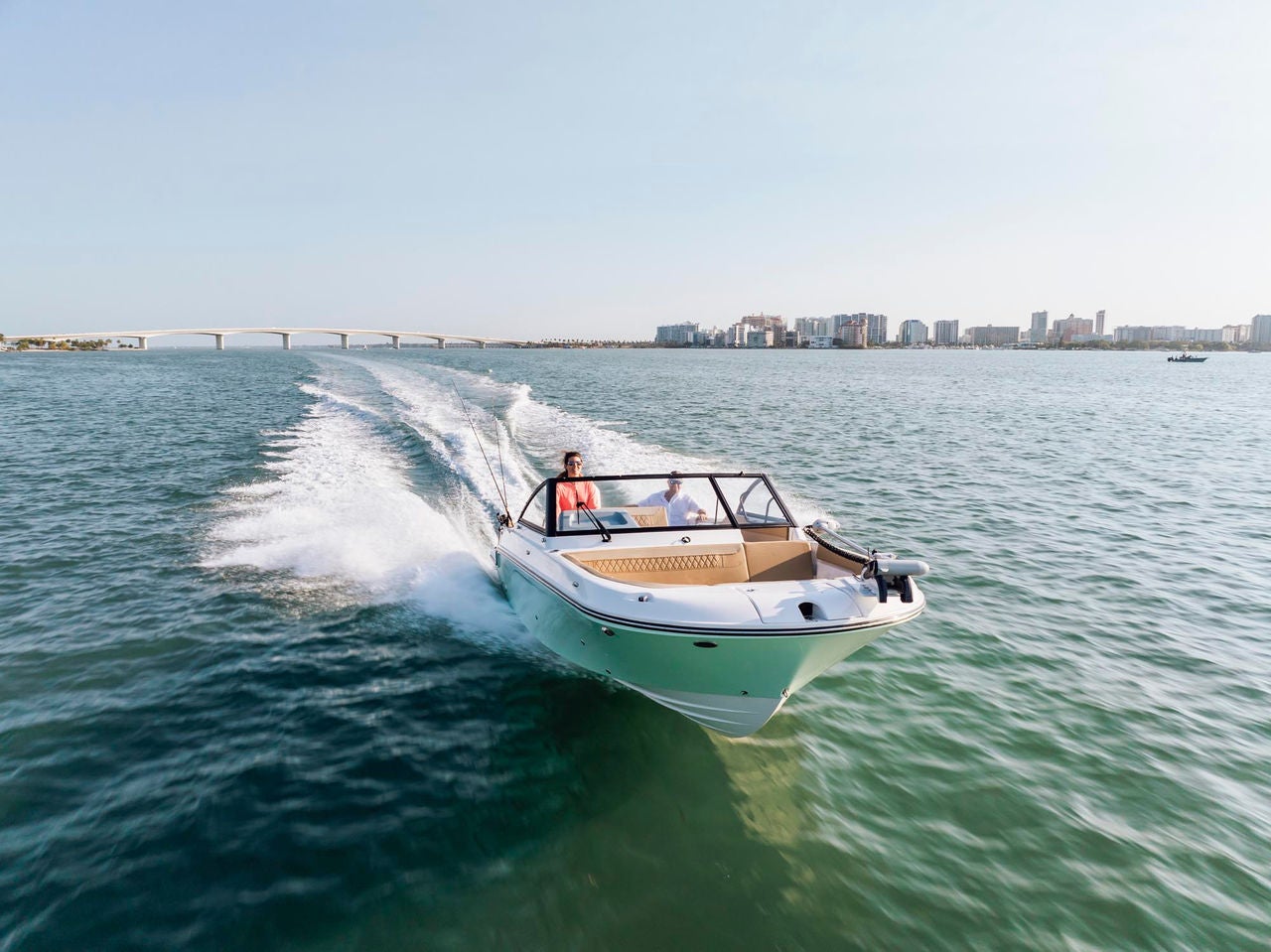
The T22SC Doesn't Pick a Side — Fishing or Family
The information provided is for general informational purposes only. This information is based on the author’s personal experience and does not constitute financial or legal advice. You should consult with a professional and/or conduct your own independent research to verify any information in this post prior to making a financial decision or otherwise.
Walk any showroom floor and a pattern emerges: fishing boats sit on one row, family runabouts on another, and buyers end up splitting the difference somewhere in the space between them. Bayliner built the Trophy T22SC specifically to erase that divide, and it does it with an unusual move — sliding the helm console over to starboard, cutting a walkthrough into the port side, and landing on a layout that doesn't belong fully to either row.
Why the Console Sits Where It Sits
Most buyers walking the docks assume the offset console is a styling choice. It's not. By stretching the console nearly all the way across the beam, Bayliner freed up enough interior volume for an actual head compartment — something a standard dual console this size usually can't pull off without eating into seating. The trade-off is that working a fish around the starboard side of the boat gets tight. Heading fore or aft, it's manageable. Anyone who's fished a true center console boat and expects the same freedom of movement around the helm will notice the difference the first weekend out.
The upside shows up in weather. A full-width windshield keeps the cockpit crew out of the spray in a way a center console simply can't, and closing off that port walkthrough gives you dual-console-style protection when conditions turn sloppy. That's the real sales pitch here: you're not buying a fishing boat with comfort features bolted on. You're buying a family boat that happens to fish hard.
The Bow Does More Work Than Most 22-Footers
Here's where the T22SC quietly separates itself from nearly everything else in its size class. Bayliner carries the boat's full beam almost all the way to the bow instead of tapering it into the usual pointed shape. That single design decision is why several adults can sit forward with legs stretched out flat — something you won't find on a typical 22-foot runabout, where bow seating usually means knees up around your chest.
Drop in the filler cushion and the whole forward section becomes a sunpad. Pull it out and you've got a genuine casting platform with raised, C-shaped seating wrapping the deck — not just a couple of flanking bolsters pretending to be casting decks. The forward hatch swings open on a gas-assist strut, revealing a stowage compartment deep enough to actually be useful rather than symbolic. Worth knowing before a sea trial: not every hatch on this boat gets that same gas-ram treatment, so ask specifically which compartments have them and which just prop open on a stick.
Fishing Gear That's Actually Thought Through
Rod storage is where a lot of dual-console boats fall apart under real use — usually there's nowhere flush-mounted forward of the windshield, forcing anglers to lay rods across seats where they get stepped on. Bayliner put two flush-mount rodholders forward of the windshield, a small detail that a surprising number of competing builders skip entirely. Aft, there are four gunwale rodholders plus flip-out hideaway racks tucked into the port inwale, so rigged rods don't have to ride exposed on a long run.
The insulated fish box under the transom bench isn't an afterthought either — reviewers testing it on the Chesapeake noted it's roomy enough to handle a keeper-size cobia, which tells you something about capacity most spec sheets won't. The 18-gallon transom livewell keeps bait alive through a full day, and the self-bailing cockpit means less time hosing down after a bloody cleaning session and more time getting the boat back on the trailer.
The Head Compartment: A Real Perk With Real Upkeep
That double-wide console isn't just marketing language — it genuinely fits a portable toilet and extra stowage, giving the crew a less cramped option than most boats this size offer. Buyers coming from a bare center console tend to love this feature immediately. What doesn't get mentioned enough at the dealership: a portable head still needs to be emptied and rinsed after every outing, and if it sits unused for a few weeks in humid storage, it will let you know. Budget for the holding tank chemical and don't expect it to behave like a pump-out marine toilet.
Picking Between the 150 and the 250
Standard power is a Mercury 150 FourStroke, but most dealers will have you sea-trial a 250. The performance gap is real — testers running the 250 recorded a 43.1 mph top end and an onto-plane time of 3.8 seconds, with handling staying smooth and predictable through hardover turns at 30 mph. Other test numbers have put the top end closer to 50 mph depending on load and rigging. The moderate 18-degree deadrise handles typical bay chop and boat wake well without beating up the ride, but this isn't a deep-V built for running offshore in anger.
The honest advice here: unless the fishing grounds are a genuine run offshore, the 150 keeps fuel burn down and trailer weight lower, and the hull's full-beam design still gets it on plane efficiently even with the smaller engine. Buyers who upsize to the 250 purely to impress the marina crowd often end up paying for performance they rarely use.
Trailering and What Storage Costs
At 8'6" beam and roughly 4,500 pounds dry, the T22SC stays within standard trailering width limits in most states without a wide-load permit, and it comes standard with a galvanized trailer with brakes — worth confirming with a dealer since a painted trailer degrades faster in saltwater environments. One challenge flagged by reviewers who've spent real time aboard: there's no factory Bimini for shade unless it's added as part of the optional package, so anyone planning full-day trips in direct sun should build that into the price before signing.
What This Means Down the Road
Crossover boats sometimes get a rougher ride at resale than a boat that commits fully to one identity — pure center consoles hold value with hardcore anglers, pure bowriders hold value with family cruisers, and hybrids can sit in between if the market is thin. The T22SC's advantage is that it was engineered from scratch as a first-of-its-kind layout for Bayliner rather than a retrofit, which gives it a distinct enough identity that it isn't competing directly against a flood of similar used inventory. That's less true of boats that try to be everything through add-on packages instead of hull design. Buyers comparing this against other 22-footers should ask what a used one has actually sold for locally, not just what the MSRP looks like new — base pricing runs from roughly $63,000 into the high $60,000s depending on rigging, with fully optioned, larger-engine builds pushing closer to $87,000.
Anyone cross-shopping this against a dual console or a straight center console should spend less time comparing spec sheets and more time asking how they'll actually use the boat on a Tuesday afternoon versus a Saturday tournament morning. The T22SC was built for people who genuinely need both answers, not just one with a fishing rod graphic on the side.
Visit your local Bayliner boat dealer to learn more.
This website does not provide financial or legal advice. The information available on this website is provided for general informational and educational purposes only and is not a substitute for professional advice. You should consult with the appropriate professionals prior to making any financial decisions. YOUR USE OR RELIANCE ON ANY OF THE INFORMATION PROVIDED HEREIN IS SOLELY AT YOUR OWN RISK. UNDER NO CIRCUMSTANCE SHALL WE HAVE ANY LIABILITY TO YOU FOR ANY LOSS OR DAMAGE OF ANY KIND INCURRED AS A RESULT OF THE USE OR RELIANCE ON ANY INFORMATION PROVIDED.