

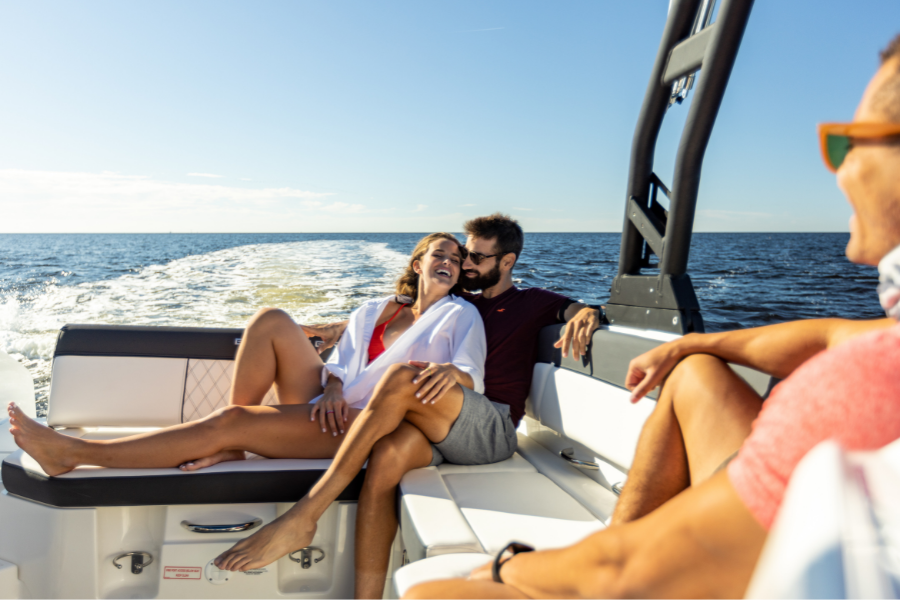
Five Things Every Boat Guest Should Know
The information provided is for general informational purposes only. This information is based on the author’s personal experience and does not constitute financial or legal advice. You should consult with a professional and/or conduct your own independent research to verify any information in this post prior to making a financial decision or otherwise.
One of the most enjoyable things about boating is inviting guests on your boat to share the experience. Keeping everyone safe on board should be your primary goal and it starts by prepping your boat for guests.
Before each cruise, make sure you bring:
- Enough life jackets for everyone, including kids, plus a few extras in case someone brings a guest
- Watersports-specific life jackets for everyone who will participate
- A throwable personal flotation device (PFD) in case anyone falls overboard
- United States Coast Guard-approved fire extinguishers
- A noise-making device in addition to your boat’s horn
- Visual distress devices, if required
- Plenty of clean, drinkable water
Before leaving the dock, give a short safety briefing.
- Make sure everyone is either wearing a life jacket or knows their location and how to put one on and adjust it properly.
- Show the location of fire extinguishers and other safety devices.
- Explain that being on the water — with the sun, wind, motion of the boat and the noise — increases the effects of alcohol, so if they are imbibing, ask that everyone does so in moderation. Encourage everyone to stay hydrated and keep well-protected with sunscreen as heat can exaggerate the effects of alcohol.
- If your boat has a VHF radio, show guests how to use it and how to go to channel 16 if there’s an emergency. Having a short checklist for its use is a good idea.
- Let everyone know where you will be going that day in case they have to tell someone else your location.
To make sure someone else can operate the boat in an emergency, offer to give turns at the helm and teach new boaters the basics.
If you are for any reason unable to captain, your best chance of getting back to land safely is if someone on board can take the helm quickly. So, if no one has ever driven a boat before, let one of your guests try it out.
- First, show them how to connect the cut-off switch that every driver is required by law to use. Explain the boat won’t operate without it being connected. Then show how to start the boat by first making sure it’s in neutral then turning the key.
- Show them how to accelerate, get on plane and trim the boat, and simulate approaching a dock to show them how to bring the throttle and shift to the neutral position to stop.
- Display a short checklist at the helm in case they forget anything.
- If your boat has a GPS, demonstrate how to read your location and remind guests their cell phones also have GPS included.
By using these safety tips for boating with groups, you’ll be able to have a fun day on the water with your guests and know that if anything happens, everyone will stay safe.
This website does not provide financial or legal advice. The information available on this website is provided for general informational and educational purposes only and is not a substitute for professional advice. You should consult with the appropriate professionals prior to making any financial decisions. YOUR USE OR RELIANCE ON ANY OF THE INFORMATION PROVIDED HEREIN IS SOLELY AT YOUR OWN RISK. UNDER NO CIRCUMSTANCE SHALL WE HAVE ANY LIABILITY TO YOU FOR ANY LOSS OR DAMAGE OF ANY KIND INCURRED AS A RESULT OF THE USE OR RELIANCE ON ANY INFORMATION PROVIDED.