

Are Bayliner Boats Good? Here's What to Know
The information provided is for general informational purposes only. This information is based on the author’s personal experience and does not constitute financial or legal advice. You should consult with a professional and/or conduct your own independent research to verify any information in this post prior to making a financial decision or otherwise.
Are Bayliner Boats Good? Here's What Owners and Dealers Know
Ask that question at a boat show and the answer depends on who you're asking. A dealer will tell you about value and Mercury power. A long-time boater might have watched the brand quietly become one of the smartest ways to get a family on the water. Both reactions point to the same truth: Bayliner has spent the better part of seventy years figuring out how to make boating less complicated, and the current lineup is the clearest proof of that yet.
The short answer is yes. Bayliner builds a genuinely good boat, and for a specific kind of buyer, it's hard to beat. Anyone cross-shopping new boats this season should understand exactly what makes these hulls tick, because the details rarely show up on a spec sheet.
Where the Confidence Comes From
Orin Edson started the company in the late 1950s on a simple idea: bundle a boat, motor, and trailer into one affordable package so ordinary families could get on the water without financing a small yacht. It worked. Bayliner became a best-selling boat brand, and it's held that kind of reach for decades.
Every new Bayliner today rolls off the same Tennessee production lines and through the same Brunswick quality process that builds Sea Ray, one of the most respected names in the industry. Buyers researching the brand deserve to know that history.
The Lineup, and What Each Boat Is Built For
Element E16 and E18 — These deck boats earn less hype than they deserve. The flat, stable hull is one of the more forgiving platforms out there for someone backing a trailer down a ramp for the first time or getting a feel for how a boat handles a no-wake zone. Buyers moving up from a pontoon are often pleasantly surprised by how much drier and tighter the ride feels in chop compared to a flat-bottom hull, a real advantage on lakes that get busy and choppy on summer afternoons.
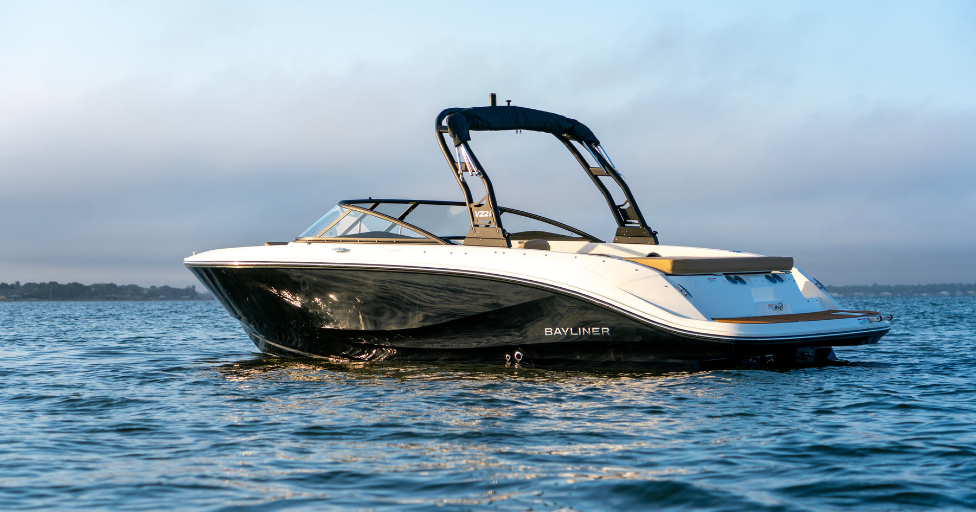
V-Series bowriders (V20, V22, V20i, V22i) — These trade some of that flat stability for a proper deep-V hull, and the payoff is a smoother, more confident ride at speed. Worth knowing before towing one home for the first time: a deep-V sits a little lower on the trailer and carries more tongue weight than an Element of similar length, which affects what tow vehicle setup makes sense. That's a fair trade for buyers who want a boat that handles a little chop with authority.
One detail worth clearing up early: the passenger ratings printed on the capacity plate (up to 10 on the V20, up to 12 on the V22) reflect U.S. Coast Guard weight-load calculations, not a recommended headcount for a comfortable afternoon out. Six to eight people with coolers and gear is where these boats feel spacious and ride their best, good information to have before planning that first big group outing.
Ownership Made Simple – With a Few Insider Habits That Make It Even Better
New ownership with Bayliner is about as low stress as boating gets, especially with Mercury power backing nearly every current model and a nationwide service network to match. A few habits, straight from people who've spent years around these boats, keep that experience running smoothly for the long haul:
- Treat fuel with a stabilizer during slower stretches. Ethanol-blended fuel that sits untouched for a few weeks can start to break down faster than most new owners expect. A splash of stabilizer at the pump during low-use periods is inexpensive insurance that keeps the fuel system running clean.
- Winterize every season, without exception, for anyone in a freeze-prone climate. Mercury's cold-weather guidelines exist for a reason and following them each fall is the single easiest way to protect the investment long-term.
- Keep the Element's self-bailing scuppers clear of leaves and sand. It takes thirty seconds after a day on the water and keeps everything draining exactly as designed.
- Rinse hardware after saltwater trips and hit cleats and hinges with a corrosion inhibitor a couple of times a season. It's a small habit that keeps everything looking and working like new for years longer.
None of this is complicated, and that's precisely the point. Bayliner is engineered so routine care stays routine.
Getting the Most Out of a Dealer Relationship
The dealer relationship matters just as much as the boat itself, and the best ones make that obvious from the first conversation. A great question to ask before signing anything: how does the service department handle the spring commissioning rush and the fall haul-out rush? A dealer who's upfront about their busiest weeks and communicates timelines clearly is worth more than one promising an unrealistic turnaround.
It's also worth confirming that Mercury-certified technicians and genuine parts are on-site, since the majority of current Bayliner models run Mercury power. That single detail determines how quickly routine service and any warranty work get handled down the road.
Storage That Protects the Investment
A little attention during the off-season pays off for years. Boats kept under a roof or properly shrink-wrapped hold their gelcoat shine and stay drier in the bilge than boats left under just a cover, which matters enormously if the boat is ever appraised or traded in down the line. It's a small seasonal habit that keeps a new Bayliner looking showroom-fresh well into its second and third summer.
Trailer care deserves equal attention. Wheel bearings work harder on a boat trailer than on nearly any other kind, cycling between submersion at the ramp and highway heat minutes later. Repacking them annually, rather than waiting for a warning sign, keeps that first long tow of the season completely uneventful.
Strong Value That Holds Up
Because Bayliner remains one of the most in-demand brands among new and growing boating families, that popularity translates directly into strong resale demand down the line. A well-maintained Bayliner tends to move quickly when it does hit the market, a real advantage for owners who like knowing their investment stays liquid. Paired with Mercury's dealer network and broad parts availability, that demand is part of what makes Bayliner ownership feel like a smart decision years after the original purchase, not just on day one.
We're In It for the Long Haul
Buyers who treat winterization and hardware care as standard practice, ask the right questions of their dealer, and take a few minutes each season to protect their investment get exactly what Bayliner is built to deliver: a boat that's ready every time the water is, with far more time spent enjoying it than worrying about it.
Contact a local Bayliner dealer today to learn more.
This website does not provide financial or legal advice. The information available on this website is provided for general informational and educational purposes only and is not a substitute for professional advice. You should consult with the appropriate professionals prior to making any financial decisions. YOUR USE OR RELIANCE ON ANY OF THE INFORMATION PROVIDED HEREIN IS SOLELY AT YOUR OWN RISK. UNDER NO CIRCUMSTANCE SHALL WE HAVE ANY LIABILITY TO YOU FOR ANY LOSS OR DAMAGE OF ANY KIND INCURRED AS A RESULT OF THE USE OR RELIANCE ON ANY INFORMATION PROVIDED.